Beyond Silicon Valley: How Kazan's Tech Ecosystem Is Quietly Redefining American R&D Strategy
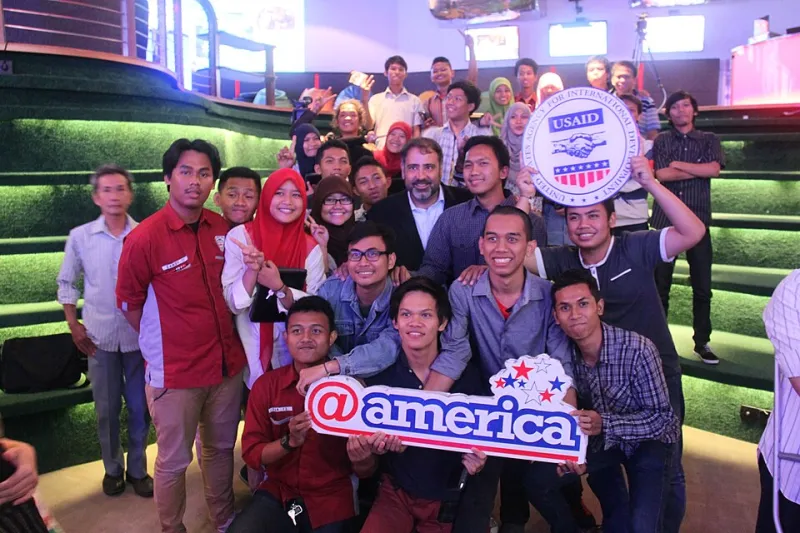
Photo: USAID Indonesia, Public domain, via Wikimedia Commons
For decades, the default assumption among American technology executives was straightforward: if you needed world-class engineering talent at a competitive price point, you looked east to Bangalore, west to Eastern Europe, or — if budget allowed — stayed home in the Bay Area. Kazan, Russia's fourth-largest city and the capital of the Republic of Tatarstan, rarely appeared on that shortlist. That calculus is beginning to change, and the shift is happening faster than most industry observers anticipated.
American R&D teams attending Kazan's growing portfolio of trade exhibitions and technology showcases are returning home with something more valuable than vendor contacts. They are returning with active development partnerships — relationships forged on exhibition floors that have matured into joint product cycles, shared IP frameworks, and measurable competitive advantages.
A Talent Pool Built on Institutional Depth
Kazan's engineering pedigree is not incidental. The city is home to Kazan Federal University, one of Russia's oldest and most respected research institutions, alongside a cluster of technical institutes that have historically supplied talent to the aerospace, defense, and petrochemical sectors. That legacy created an engineering culture oriented toward precision, systems thinking, and applied problem-solving — qualities that translate directly into the kind of R&D collaboration American technology firms require.
What distinguishes Kazan's talent pool from comparable Eastern European markets is the concentration of engineers with cross-disciplinary expertise. Software developers here frequently carry backgrounds in mechanical engineering, materials science, or industrial mathematics. For American companies building products at the intersection of hardware and software — industrial IoT devices, embedded systems, or advanced manufacturing tools — that combination is difficult to replicate elsewhere at comparable cost.
One U.S.-based industrial automation firm, which connected with a Kazan startup at a regional technology exhibition two years ago, reported cutting its firmware development cycle by nearly 30 percent after integrating a Kazan-based team into its product workflow. The firm's VP of Engineering noted that the Kazan engineers arrived with a working familiarity with legacy industrial protocols that his domestic team had spent months attempting to decode independently.
Exhibition Floors as Innovation Matchmakers
Kazan's trade exhibition ecosystem has evolved into something more than a conventional vendor marketplace. The city's major commercial showcases now function as structured environments for technology scouting — a role that American firms are increasingly leveraging with deliberate intent.
Rather than attending purely to sell, a growing cohort of American technology companies is sending product development leads and chief technology officers to Kazan exhibitions specifically to identify collaborative partners. The format lends itself to this purpose. Multi-day exhibitions allow for the kind of extended technical dialogue that a brief conference session or a cold LinkedIn message cannot replicate. Engineers speak to engineers. Prototypes get examined. Feasibility conversations happen in real time.
ExpoKazan has observed this shift in attendee behavior across successive exhibition cycles. American delegations that once arrived with sales objectives are now arriving with technical briefs — detailed descriptions of development challenges they are actively trying to solve. Kazan-based startups and engineering firms have adapted accordingly, preparing capability demonstrations and case portfolios specifically designed for an international audience evaluating partnership potential rather than procurement options.
The Cost Equation Without the Quality Compromise
Any honest analysis of Kazan's appeal to American R&D teams must address the economics directly. Hourly engineering rates in Kazan remain substantially lower than equivalent talent in the United States, and meaningfully lower than comparable Western European markets. For mid-market American technology companies operating under genuine budget constraints — firms that cannot absorb the burn rate of a fully domestic development team but are equally unwilling to accept the quality risks associated with low-cost offshore models — Kazan occupies a compelling middle position.
The quality argument, once the primary objection raised by skeptical American executives, has been progressively dismantled by documented outcomes. American firms that have formalized Kazan partnerships consistently report that the engineering output meets or exceeds the standards they would expect from domestic contractors. Several have noted that Kazan-based teams demonstrate a particular strength in documentation and testing rigor — disciplines that can be inconsistent in faster-moving, higher-cost markets.
This combination of competitive pricing and reliable quality is not accidental. Kazan's technical workforce developed within institutional environments that rewarded methodical precision over speed, a cultural orientation that translates into development practices American product managers frequently describe as refreshingly disciplined.
Navigating the Partnership Landscape
Building a productive R&D relationship with a Kazan-based firm requires preparation that goes beyond standard vendor due diligence. American companies that have succeeded in this market consistently identify several practices as essential.
First, intellectual property frameworks must be established before collaborative work begins. Kazan's legal environment for commercial IP agreements has become more navigable in recent years, and experienced local legal counsel can structure arrangements that protect American interests while remaining workable for the Kazan partner. Companies that have attempted to apply standard U.S. contractor agreements without local adaptation have encountered friction; those that engaged specialized counsel early report far smoother onboarding processes.
Second, communication infrastructure matters more than many American teams initially anticipate. The eight-hour time difference between Kazan and the U.S. East Coast demands deliberate workflow design. Successful partnerships typically establish defined synchronous windows — usually early morning Eastern time — and invest in documentation practices that allow asynchronous progress during the hours when teams are not simultaneously online.
Third, and perhaps most importantly, the most productive Kazan partnerships are initiated through direct, in-person engagement rather than remote introductions. The trust architecture that underpins serious technical collaboration builds most reliably through face-to-face interaction. Kazan's trade exhibitions provide exactly that environment — a structured, professionally curated setting in which American executives can conduct the kind of extended technical evaluation that remote communication cannot substitute.
Positioning for the Next Development Cycle
The American companies currently deepening their Kazan partnerships are not operating on short time horizons. They are making calculated bets that the city's innovation infrastructure — already substantial — will continue to develop in ways that compound the advantages of early engagement. Kazan's municipal and regional authorities have invested meaningfully in technology park infrastructure, startup incubation programs, and international business facilitation over the past decade. That investment is producing results that are now visible to the American firms paying close attention.
For technology executives who have not yet evaluated what Kazan's engineering ecosystem could contribute to their product development strategy, the relevant question is no longer whether the opportunity is real. The documented outcomes of existing American-Kazan R&D partnerships have settled that debate. The operative question is how much longer a deliberate delay in exploration remains defensible — and what it will cost in competitive positioning to be among the last to find out.