Off-Season, Overlooked, Outperformed: The Real Cost of Abandoning Kazan Between Peak Exhibitions

There is a particular kind of financial loss that never appears on a balance sheet. No line item captures it, no quarterly review flags it, and no CFO ever presents it to the board. It is the loss of deals that were never initiated, relationships that were never formed, and contracts that were signed by a competitor who simply showed up when you did not.
For a growing number of American sales organizations operating in the Eurasian market, that invisible loss is accumulating in Kazan — and it is accumulating during the months they have collectively decided do not matter.
The Peak-Season Trap
The logic that drives most American sales teams toward Kazan's flagship spring and autumn exhibition cycles is understandable. Major trade events concentrate buyers, generate media attention, and justify the travel budget in a single, auditable block. Attendance at a large-format expo is easy to defend in an expense report. Attendance at a mid-January sectoral forum with three hundred participants is considerably harder to explain to a vice president who has never set foot in Tatarstan.
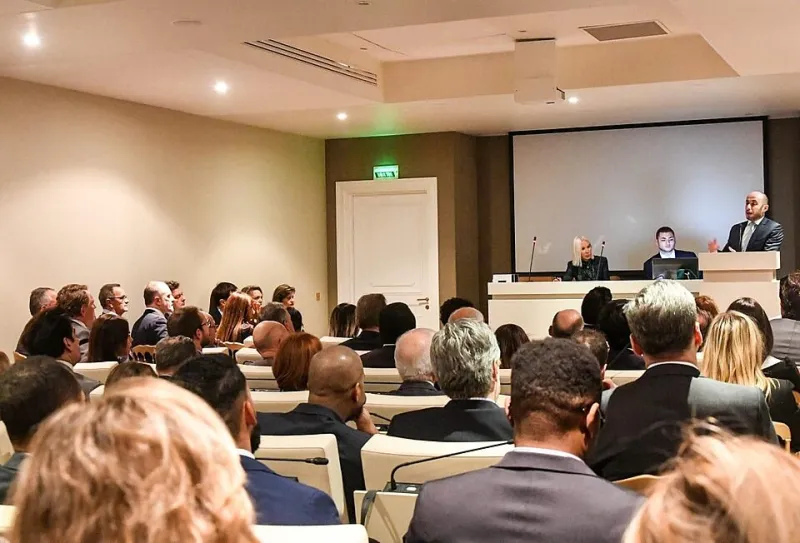
That organizational bias toward peak-season events has created a structural blind spot. While American delegations arrive en masse for the marquee shows, a separate and often more commercially decisive calendar of activity unfolds across the rest of the year — industry-specific roundtables, procurement forums, technology showcases, and regional business councils that draw precisely the decision-makers who are too busy, or too selective, to spend three days on a crowded exhibition floor.
The vendors filling those rooms are not primarily American. They are regional competitors, European firms with permanent Kazan offices, and a growing cohort of Asian manufacturers who long ago stopped treating the city as a seasonal destination.
What the Data Suggests About Deal Velocity
Relationship-driven markets operate on a fundamentally different timeline than transactional ones. In Kazan, as across much of the broader Volga-Ural commercial corridor, the progression from introduction to signed contract typically requires multiple touchpoints across an extended period. Industry practitioners who have tracked deal cycles in the region consistently report that contracts originating from off-season interactions — where delegations are smaller, conversations are longer, and follow-up is less diluted by the noise of a major exhibition — tend to close faster and at higher average values than those initiated during peak events.
The mechanism is not complicated. A purchasing director who meets ten American vendors in three days at a spring expo has limited bandwidth to develop meaningful familiarity with any of them. The same director, encountered at a forty-person sectoral workshop in October, is an entirely different conversation partner. The ratio of attention to competition shifts dramatically, and in relationship-dependent commercial environments, attention is the scarce resource that precedes trust — and trust is what precedes contracts.
American sales teams that operate exclusively within peak-season windows are, in effect, choosing to compete in the most crowded and attention-scarce environment available to them, while leaving the less competitive, higher-conversion environments entirely to rivals.
The Compounding Effect of Continuous Presence
There is a second-order consequence to year-round engagement that peak-season visitors rarely account for: the compound value of recognized presence. In markets where business relationships are built incrementally, the vendor who appeared at last spring's expo, the autumn forum, the winter procurement roundtable, and the early spring technical briefing occupies a categorically different position in a buyer's mental landscape than the vendor who arrives once a year with a polished booth and a fresh set of business cards.
This is not merely a matter of brand familiarity, though that matters considerably. It is a matter of perceived commitment. Buyers in Kazan's commercial ecosystem — whether they represent manufacturing conglomerates, state-affiliated procurement bodies, or independent distributors — apply an informal but consequential filter to their supplier relationships: does this partner treat us as a primary market, or as an opportunistic add-on?
American companies that maintain a visible presence across the full annual calendar signal, without ever stating it explicitly, that Kazan is a strategic priority rather than a speculative experiment. That signal carries commercial weight that no pitch deck can fully replicate.
What Off-Season Events Actually Look Like
For American sales executives unfamiliar with Kazan's year-round event infrastructure, the off-season calendar may appear sparse when viewed from a distance. It is not. The city hosts a continuous rotation of industry-vertical events across sectors including advanced manufacturing, agribusiness, information technology, logistics, and financial services. Many of these are organized in collaboration with Tatarstan's regional development bodies and carry the participation of institutional buyers whose procurement authority is substantial.
Additionally, the ExpoKazan platform and its affiliated networks facilitate smaller-format networking sessions and business matching events throughout the calendar year — precisely the environments in which relationship depth develops most efficiently. These are not consolation prizes for vendors who missed the main show. They are, for those who understand how the market operates, often the more valuable investment.
Recalibrating the Presence Strategy
The practical implication for American sales leadership is not that peak-season exhibitions should be abandoned or deprioritized. They remain valuable, and the deal flow they generate is real. The implication is that a Kazan strategy built exclusively around those events is, by design, a partial strategy — one that captures a fraction of the available opportunity while leaving the remainder to competitors with broader calendars and longer time horizons.
Organizations that have begun to recalibrate their approach typically do so by identifying two or three off-season events annually that align with their specific sector and buyer profile, assigning a consistent representative rather than rotating delegates, and establishing a follow-up infrastructure that maintains contact between events rather than treating each visit as a discrete episode.
The investment required is modest relative to the cost of a full peak-season exhibition presence. The return, measured in deal velocity, contract value, and competitive positioning, is disproportionately large.
The Quiet Penalty of Absence
Markets do not pause for the vendors who are not present. In Kazan, as in any commercially active environment, relationships form, preferences solidify, and contracts get signed on a continuous basis — not on a schedule that accommodates the travel budgets of companies that have not yet decided to take the city seriously year-round.
The American sales teams losing ground in this market are not losing it dramatically. There is no single moment of defeat, no lost bid that can be pointed to as the turning point. The loss is quieter and more cumulative than that. It is the sum of conversations that did not happen, of trust that was not built, of contracts that went to the vendor who was simply present when the decision was being made.
That is the hidden tax on missed connections. And unlike most taxes, it is entirely optional.